
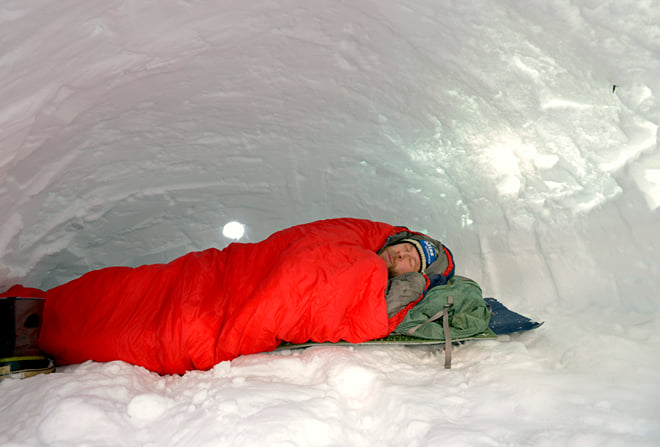
Bliss guide will meet the clients at the CAMP Kitchen & Bar in Pyhä. After meet and greet, the Bliss representative will take the clients to suitable premises for a theory work shop about arctic nature and arctic survival skills and, introducing both the traditional and contemporary techniques. Bliss' survival instructor will introduce the relevant gear, such as arctic sleeping bags and sleeping mats, clothing items, give insight information about various materials and their suitability for challenging environment. Also clothing items for the extreme cold and various stove systems will get discussed. A light but nutritious meal will be served. Going out. Weather conditions allowing (temperature, wind, amount of snow, etc.) survival instructor will present how to build a quinzee (pronounced ”kwinzi”, in Finnish “lumikammi”). It is a traditional snow shelter, made by hollowing out a pile of settled snow, a well-proven method of surviving the arctic night. Clients are expected to participate to build their own quinzee. It will take a couple of hours for a group. Another snack or a meal will be served. Group gets prepared for the night-stay in the quinzee, which they created by themselves with instructions from the Bliss representatives. Bliss guide will monitor the night. In case of emergency or if the clients requests so, he/she can be relocated into a warm back up building closeby. At the wake up some warm drinks and a nutritious morning snack will be served. Also every client will get interviewed individually to make sure that everyone is fine after the night. The adventure will end as a Bliss guide will walk the clients back to civilization. Pick-up for this experience is available from the locations listed below for an additional fee. This option can be selected either from Extras or during the booking process, depending on the booking channel. Kurula's Resort Northern Lights Village Pyhä (at the front of the restaurant) Sunday Morning Resort Lucky Ranch - Saloon (at the front of the restaurant) Visit Pyhä Cabins Amethyst Shop in Luosto Note: Pick-up from Luosto starts 30 minutes before departure. Pick-up from Pyhä locations starts 15 minutes before departure. If there are many customers at different pickup points, it is important to arrive on time and wait patiently for your own ride.
Highlights
- Once-in-a-lifetime experience.
- Adventurous though safe day and night in the Arctic wilderness, under the stars and possible Northern Lights.
- Building a quinzee and sleeping in snow, rather comfortably.
What's included
- A theory lesson: introduction to Arctic nature and Arctic survival
- Guiding and storytelling
- A quinzee building presentation and instructions (weather permitting)
- Use of winter sleeping bag and sleeping mat
- Meal, snacks and warm drinks
- Information about the regional flora and fauna, focusing on winter
Meeting point
CAMP Kitchen & Bar Pyhä, Kultakeronkatu 21, Pyhätunturi (Pelkosenniemi)
Book this experience
Will I see the northern lights?
The straight answer: probably, if you give yourself a few nights — but nobody can promise it. Here is what the odds actually look like, what decides them, and exactly what we do about it.
What actually decides whether you see them
Three things, and only one of them is about the aurora itself. This is why two people in the same town on the same night have completely different trips.
The aurora is above the clouds. On most disappointing nights the lights were there and the sky was simply covered. Cloud is the single biggest factor, and it is local — 40 km can be the difference between overcast and clear.
Street lighting washes out weak displays. From a lit hotel car park you need a strong show to notice anything; from a dark lake or fell 20–30 minutes out of town, a faint arc is already visible to the eye.
One night is a coin toss no matter where you stay. Three nights is when the odds move firmly in your favour, because you only need one of them to break clear.
A faint aurora often reads as a pale grey-green band to the naked eye and only turns vivid green in a long-exposure photo. That is normal physics, not a weak display — and it is why our guides shoot for you.
What we do to maximise your chances
We cannot change the sky, but almost everything else on this list is a decision someone makes on the night.
- Guides check aurora and cloud forecasts through the evening and pick the departure point on the night, not in advance.
- Tours are mobile — if the sky closes in at the first spot, we drive to the nearest gap instead of waiting it out.
- We head away from town light to dark lakes, fells and forest clearings.
- Thermal overalls, boots, gloves and a hot drink so you can stay outside long enough to actually catch a display.
- Small groups, so the vehicle can move quickly when conditions change.
- Late-evening timing that covers the 21:00–01:00 window when activity most often peaks.
- Guides photograph the display for you, so a faint aurora still comes home as a real picture.
Use an aurora alert app while you are here
A good alert app tells you when it is worth stepping outside — useful on the nights you are not on a guided tour.
How aurora alert apps work
Satellites at the L1 point (NASA/NOAA's DSCOVR and ACE) measure the solar wind — its speed, density and the direction of the magnetic field it carries — about 30–60 minutes before it reaches Earth. That data feeds the app.
Finland has a dense network of ground magnetometers. When the aurora energises the sky above, the local magnetic field starts to swing. Apps built for Finland trigger on that local disturbance, which is far more reliable here than a global Kp number alone.
You set a sensitivity level and the app notifies you when activity crosses it, typically minutes before or as a display begins. You can usually set quiet hours so it only wakes you when it is genuinely worth it.
Activity is only half the story. Check the alert against a cloud forecast — if the sky above you is overcast, drive to a gap or wait. The apps show forecast and current conditions to help with exactly that call.
An alert means the aurora is likely active, not that it is visible from where you stand. Clouds, city lights and a bright moon can still hide it — and a quiet reading does not rule out a sudden substorm.
If the aurora doesn't appear
The northern lights are a natural phenomenon. We track the forecasts and take you where conditions look best, but nobody can control solar activity or the weather — and no honest operator can guarantee a sighting. We would rather tell you that up front than sell you a promise nobody can keep.
- There is no sighting guarantee on our aurora tours, and we will never claim one.
- The tour runs as described whether or not the lights appear — the drive, the guiding, the location and the equipment are what you are booking.
- Departures are cancelled for safety reasons, not for a quiet aurora forecast. If we cancel, you are refunded in full.
- Plan two or three aurora nights rather than one. It is the single most effective thing you can do.
Related guides
All guides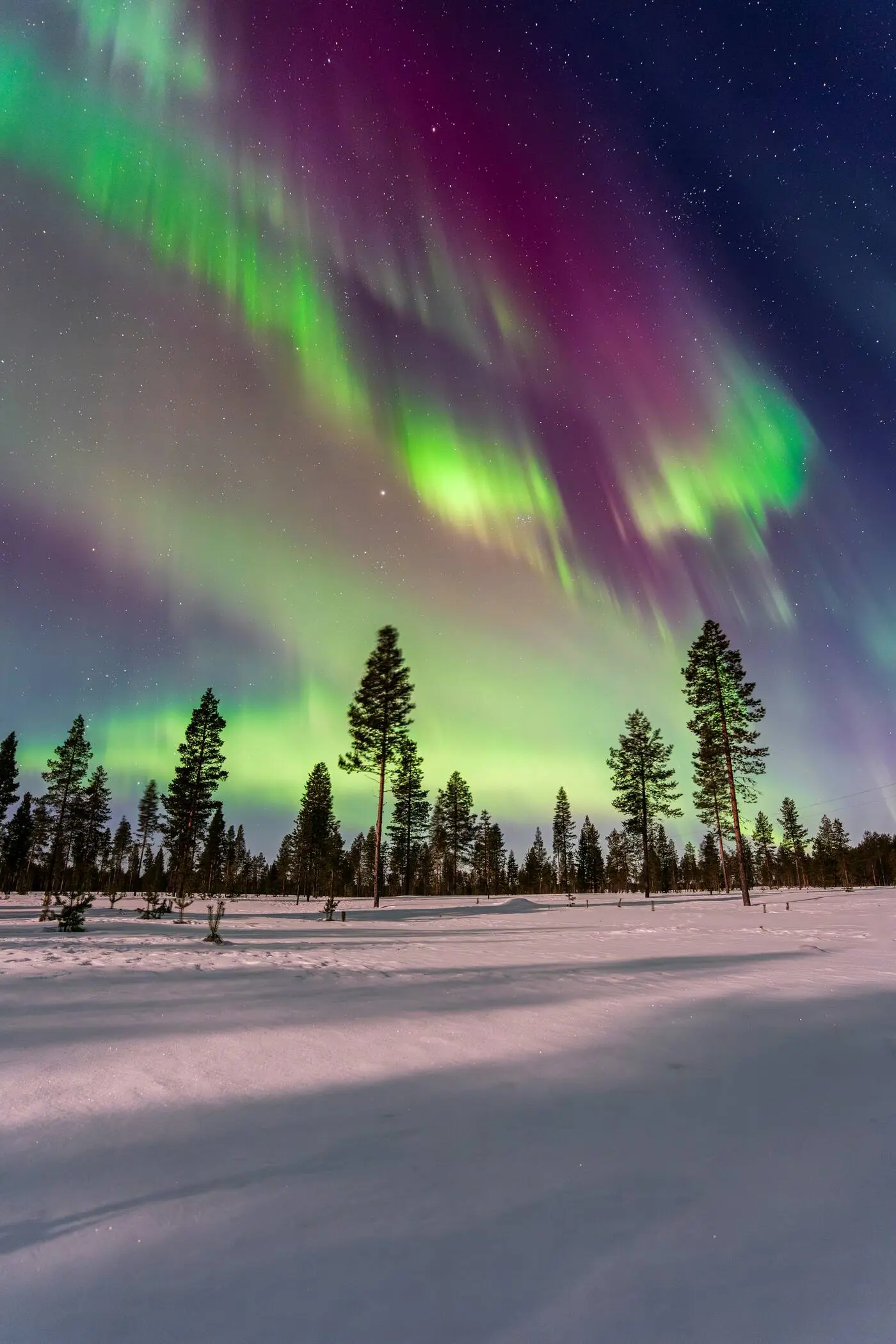
Best time to see the Northern Lights in Lapland
Late August to early April is aurora season above the Arctic Circle. Here's how each month differs, and what really moves the needle on your chances.
Read the guide →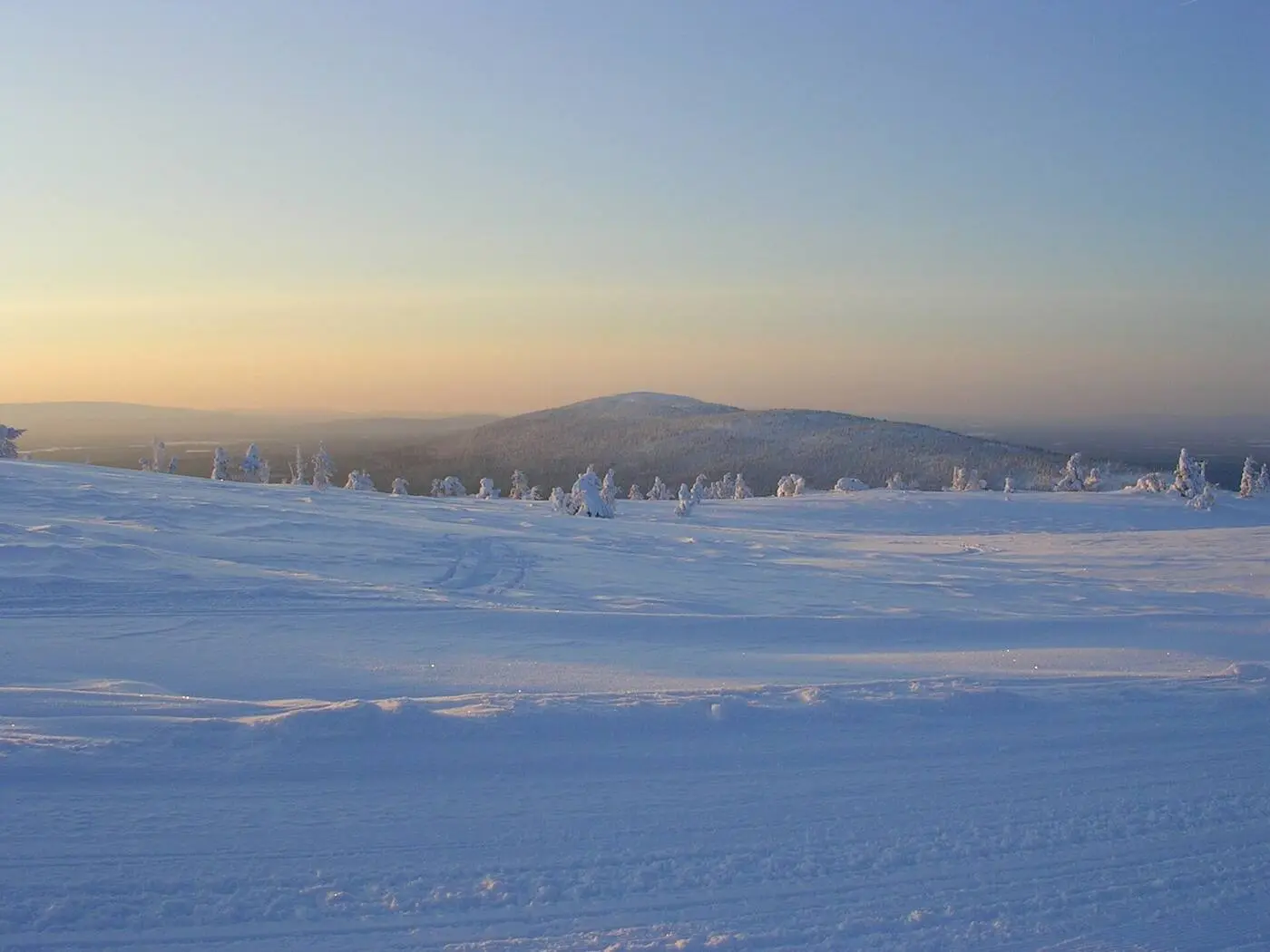
Northern Lights photography — settings and tips
You don't need a $5,000 setup to photograph the northern lights — but you do need a tripod, manual control and a few small habits that make the difference between blurred green smudges and the shot you came for.
Read the guide →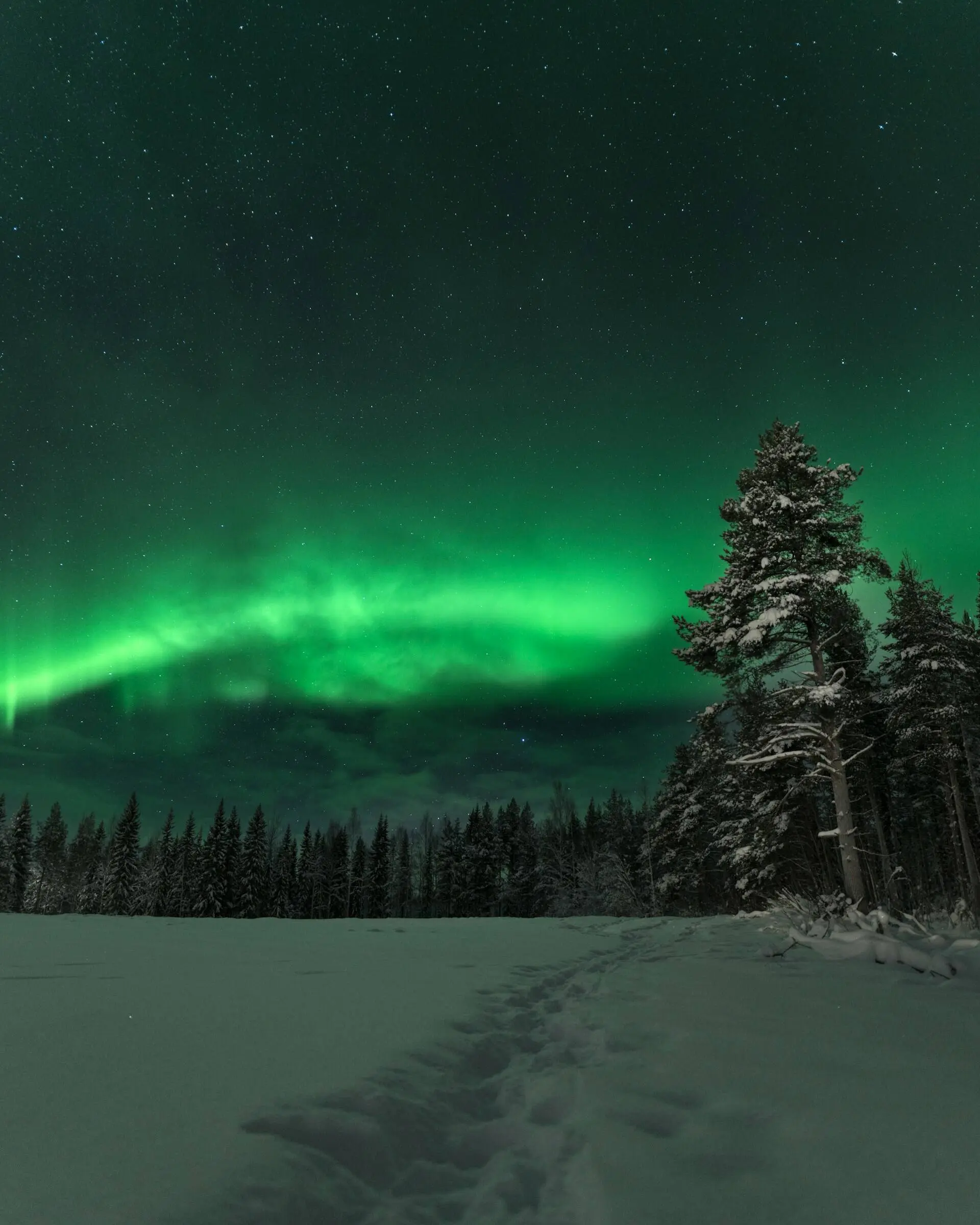
What to pack for Lapland in winter
Three layers, the right boots, and a few small things most visitors forget. Plus a clear picture of what operators lend you, so you don't haul gear you don't need.
Read the guide →